

Losing most or all of your teeth affects more than how you eat. It changes how you speak, how you feel day-to-day, and the long-term structure of your jaw. For many people facing significant tooth loss, full mouth dental implants are one of the most thoroughly researched tooth replacement options available today.
Understanding how this treatment works, what the process involves, and what factors affect suitability can help you have a more informed conversation with your dentist.
Quick Overview
- Full mouth dental implants replace all teeth in one or both arches using titanium posts anchored into the jawbone to support a fixed set of replacement teeth
- Adults with significant tooth loss, failing teeth, or dentures that no longer fit well may be suitable candidates; individual suitability depends on a detailed clinical assessment
- A staged process covers consultation, imaging, surgical placement, a healing period, and final restoration, typically spanning several months
- Jawbone density, gum health, overall medical history, and oral hygiene habits all affect how treatment progresses and what results may look like
- A clinical evaluation including X-rays and a review of your dental and medical history is the starting point for determining whether this treatment may suit you
Individual outcomes vary. Below, we explain what full mouth dental implants involve, what the research says, and what to consider before booking a consultation.
What Are Full Mouth Dental Implants?
Full mouth dental implants are a restorative dental treatment that uses multiple titanium implant posts, anchored into the jawbone, to support a full arch of replacement teeth. Rather than one implant per tooth, full arch approaches such as All-on-4 use a smaller number of strategically placed implants to support an entire row of upper or lower teeth.
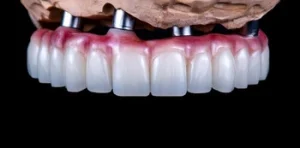
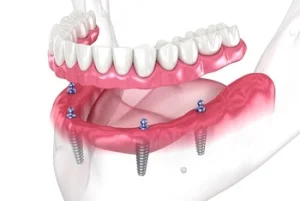 The titanium post acts as an artificial tooth root. Once placed, it integrates with the surrounding jawbone through a biological process called osseointegration. A custom-made prosthesis, shaped and coloured to match natural teeth, is then attached to the implants once healing is sufficiently advanced.
Unlike removable dentures, full arch implant restorations are fixed in place. They do not require adhesives and do not shift during eating or speaking. According to the Australian Government’s health information service, a dental implant can support a crown, dental bridge, or denture, with the post anchored directly into the jawbone where natural tooth roots once sat.
Full mouth implants are distinct from single-tooth implants in their scope. They are designed for people who have lost most or all teeth in an arch, rather than one or a few isolated teeth.
What Does the Research Say About Dental Implants?
Long-term clinical data on dental implants is well established. The Australian Dental Association notes that dental implants carry a high success rate when properly maintained, with outcomes across diverse patient populations reflecting the importance of bone quality, gum health, and ongoing care.
Where failures do occur, they are most commonly recorded during the early osseointegration phase, before prosthetic reconstruction is complete.
Individual results depend on clinical factors specific to each person, including jawbone quality, oral health status, and medical history.
What Affects Suitability for Full Mouth Dental Implants?
Not everyone is immediately suitable for full mouth dental implant treatment. Several factors are assessed during a clinical evaluation to determine whether implants are appropriate and, if so, what preparatory steps may be needed.
Jawbone density and volume: Implants require sufficient bone to anchor securely. Tooth loss over time can lead to gradual bone resorption in the jaw. Where bone density is insufficient, bone grafting may be recommended before implant placement to rebuild the foundation. 3D imaging or CT scans are typically used to assess bone height and width accurately.
Gum health: Active gum disease (periodontitis) must be treated before implant placement can proceed. Infection in the gums can spread to tissues surrounding an implant and increase the risk of failure. A dentist will assess gum pocket depth, inflammation, and bone levels around remaining teeth during an evaluation.
General health and medical history: Certain systemic conditions, including uncontrolled diabetes, autoimmune disorders, and medications that affect bone density or immune function, can influence how the body heals after implant surgery. Smoking is also associated with reduced blood flow to gum tissue, which can slow healing and affect integration. Your dental team will review your complete medical history as part of the consultation process.
Oral hygiene commitment: Implants require the same level of care as natural teeth, and consistent oral hygiene habits are a key factor in long-term outcomes. Ongoing maintenance and regular dental visits are central to keeping implants and the surrounding tissues healthy over time.
How to Care for Full Mouth Dental Implants
Implant-supported teeth require consistent daily care. Brushing twice daily and cleaning between the implants and prosthesis with interdental brushes or floss, alongside regular dental check-ups, are the core maintenance requirements.
 The Australian Dental Association recommends that people with dental implants attend regular professional dental cleans and review appointments. Your dental team can monitor the condition of the implant, surrounding gum tissue, and bone levels over time, supporting early detection of any changes.
Habits such as smoking or grinding (bruxism) can place excess pressure on implants and surrounding structures. A dentist may recommend a night guard if grinding is identified during assessment. Avoiding chewing very hard foods or objects helps protect the prosthesis and implant components.
At Sure Smile Dental in Coopers Plains, Dr Boby Thomas takes a patient-centred approach, focusing on education and long-term oral health outcomes. The team works with patients to develop maintenance routines suited to their individual situation.
A Considered Approach to Full Mouth Dental Implants
Full mouth dental implants represent a significant dental treatment that requires thorough assessment, planning, and a commitment to aftercare. Individual suitability is determined through an initial consultation, not before it.
If you would like to understand whether full mouth dental implants may be an appropriate option for your situation, call Sure Smile Dental on (07) 3185 2387 or book a consultation online.
Note: Any surgical or invasive procedure carries risks. Before proceeding, you should seek a second opinion from an appropriately qualified health practitioner.
Frequently Asked Questions
Are full mouth dental implants suitable for everyone?
Not everyone is immediately suitable for full mouth dental implants. Suitability depends on jawbone density, gum health, general medical history, and lifestyle factors such as smoking. Some patients require preparatory treatment, such as gum disease management or bone grafting, before implant placement can proceed. A thorough clinical assessment is the appropriate starting point for determining whether this treatment may suit your situation.
How long does the full mouth dental implant process take?
The overall treatment timeline typically spans several months and varies depending on individual clinical factors. Where preparatory procedures such as bone grafting are needed, the timeline extends further to allow adequate healing before implants are placed. Your dentist will outline an estimated timeline during the consultation and planning stage, based on your specific situation.
What is the difference between full mouth dental implants and dentures?
Full mouth dental implants are fixed to the jawbone and remain in place. Traditional removable dentures rest on the gum surface and may require adhesives to stay in position. Implant-supported restorations do not shift during eating or speaking and, because they stimulate the jawbone, may help slow the rate of bone resorption associated with tooth loss. The most suitable option depends on an individual’s clinical situation and treatment goals.
Can full mouth dental implants fail?
Implant failure can occur, most commonly during the early osseointegration phase. Risk factors associated with failure include active gum disease at the time of placement, smoking, uncontrolled systemic conditions, and insufficient bone density. Following the recommended care and maintenance routine and attending regular review appointments supports long-term stability. Individual outcomes vary.
What does getting full mouth dental implants involve at the consultation stage?
The initial consultation for full mouth dental implants typically involves a clinical examination of your mouth and gums, X-rays or 3D imaging to assess jawbone structure, and a review of your dental and medical history. Based on this assessment, your dentist will discuss whether you are a suitable candidate, what preparatory steps may be required, and what a tailored treatment plan might look like for your situation.
Do I need to have my remaining teeth removed before getting full mouth dental implants?
In many cases, yes. Any remaining teeth in the arch being treated will need to be extracted before or at the time of implant placement. Your dentist will assess each tooth individually to determine whether extraction is necessary. Where extractions are needed, this is factored into the overall treatment plan and timeline. The decision depends on the condition of your remaining teeth, your jawbone health, and the approach best suited to your situation.
References
Australian Dental Association. (n.d.). ‘Dental Implants’. Teeth.org.au. https://www.teeth.org.au/dental-implants
Better Health Channel. (2025). ‘Teeth and mouth care’. Department of Health, State Government of Victoria, reviewed 25 July 2025. https://www.betterhealth.vic.gov.au/health/conditionsandtreatments/teeth-and-mouth-care
Healthdirect Australia. (2025). ‘Dental implant procedure’. Healthdirect Australia, reviewed February 2025. https://www.healthdirect.gov.au/dental-implant
Healthdirect Australia. (2025). ‘Gum disease’. Healthdirect Australia, reviewed February 2025. https://www.healthdirect.gov.au/gum-disease


Getting dental implants entails more than simply restoring your smile; it also necessitates a full grasp of the accompanying expenditures. Read more



Recent Comments